Evidence of Growing Intermediate-Mass Black Holes
A Long-Standing Mystery in Black Hole Evolution
The discovery of evidence of growing intermediate-mass black holes represents a major breakthrough in astrophysics, addressing one of the most persistent gaps in black hole research. Intermediate-mass black holes, which fall between stellar-mass and supermassive black holes, are believed to be a crucial evolutionary stage in cosmic history. Their existence helps explain how supermassive black holes reached enormous sizes so quickly in the early universe, a puzzle that has challenged astronomers for decades.
The Missing Link Between Small and Giant Black Holes
Intermediate-mass black holes occupy a difficult-to-detect mass range, which is why their existence remained uncertain for so long. Stellar-mass black holes form from collapsing stars, while supermassive black holes dominate the centers of galaxies, yet the pathway connecting these two populations was unclear. Growing evidence now supports the idea that intermediate-mass black holes naturally bridge this gap, evolving over time through steady growth and mergers.
Clues Hidden in Dwarf Galaxies
Some of the strongest evidence for growing intermediate-mass black holes comes from observations of dwarf galaxies. These small galaxies lack the massive central structures typically associated with supermassive black holes, yet astronomers have detected compact objects at their cores emitting powerful X-rays and energizing surrounding gas. Such emissions are a clear indicator of active accretion, demonstrating that these black holes are not relics but are continuing to grow.
X-Ray Observations Reveal Active Growth
NASA’s Chandra X-ray Observatory and ESA’s XMM-Newton have played a critical role in identifying intermediate-mass black hole candidates. Their observations show fluctuating X-ray brightness and energy output consistent with black holes consuming matter. These signals cannot be easily explained by stellar processes alone, reinforcing the conclusion that intermediate-mass black holes are actively feeding and increasing in mass.
JWST Opens a Window to the Early Universe
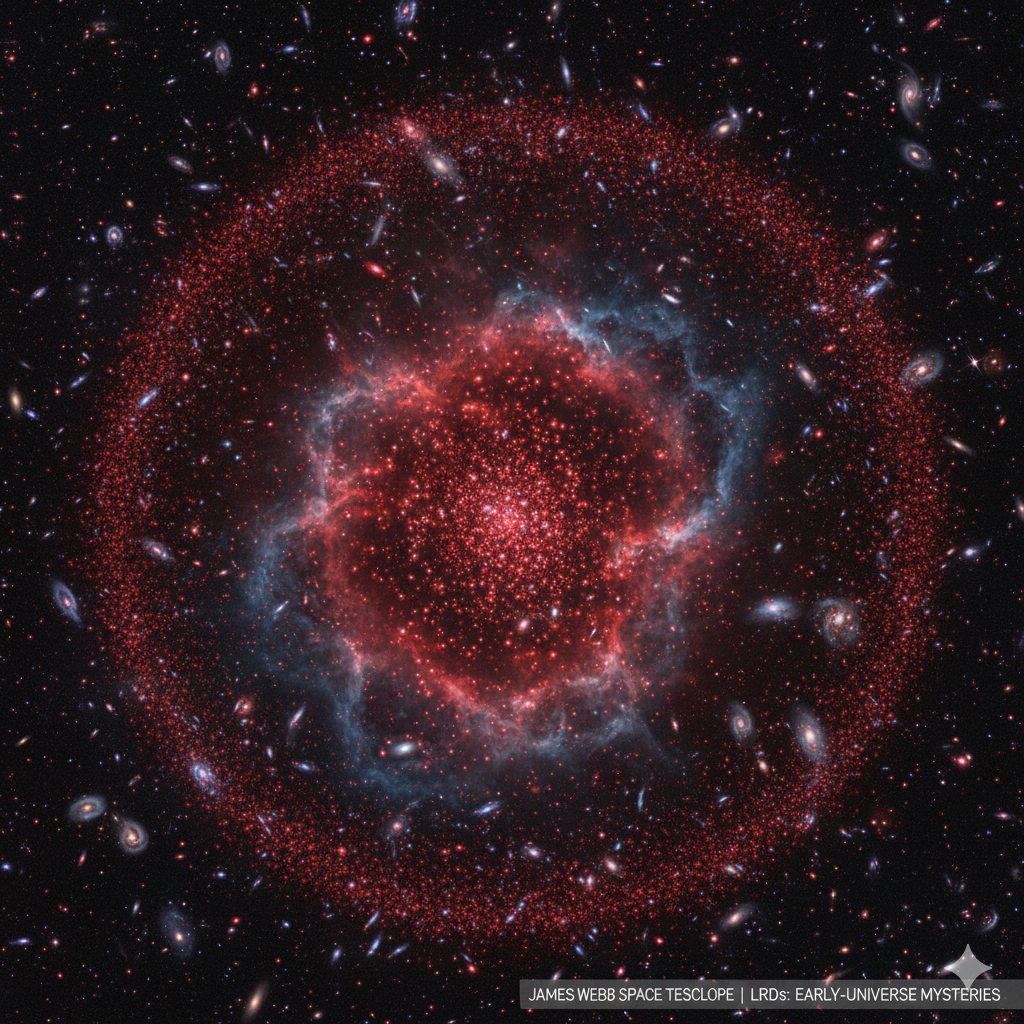
The James Webb Space Telescope has provided unprecedented insight into black hole growth during the universe’s earliest epochs. JWST has detected compact, luminous sources in young galaxies that are too massive to be stellar black holes yet not large enough to qualify as supermassive. These observations strongly suggest the presence of rapidly growing intermediate-mass black holes just a few hundred million years after the Big Bang.
Ultraluminous X-Ray Sources Strengthen the Case
Ultraluminous X-ray sources were once considered exotic stellar systems, but many are now interpreted as intermediate-mass black holes accreting matter at extreme rates. Their extraordinary brightness and variability place strong constraints on their mass, making them some of the most compelling evidence for this elusive black hole population. These sources provide direct insight into how intermediate-mass black holes gain mass over time.
How Intermediate-Mass Black Holes Form and Grow
Current theoretical models suggest several pathways for the formation of intermediate-mass black holes, including runaway stellar collisions in dense star clusters, direct collapse of massive gas clouds, and mergers of smaller black holes. Once formed, these objects can grow efficiently by pulling in surrounding gas or merging with other black holes, eventually becoming the seeds of supermassive black holes.
Why These Discoveries Matter for Cosmology
The confirmation of growing intermediate-mass black holes reshapes our understanding of galaxy formation and cosmic evolution. Their existence provides a natural explanation for the rapid appearance of massive black holes in the early universe and helps explain why nearly all large galaxies host a central black hole. These objects influence star formation, regulate galactic environments, and shape the large-scale structure of the universe.
The Future of Intermediate-Mass Black Hole Research
The next decade promises even stronger evidence as new observatories come online. ESA’s upcoming LISA mission will detect gravitational waves from merging intermediate-mass black holes, offering direct measurements of their masses and growth histories. Combined with continued JWST observations and advanced X-ray surveys, future research will bring scientists closer to fully understanding how intermediate-mass black holes form, grow, and shape the cosmos.