Little Red Dots (LRDs): Unveiling the Early-Universe Mysteries
What Are Little Red Dots (LRDs)?
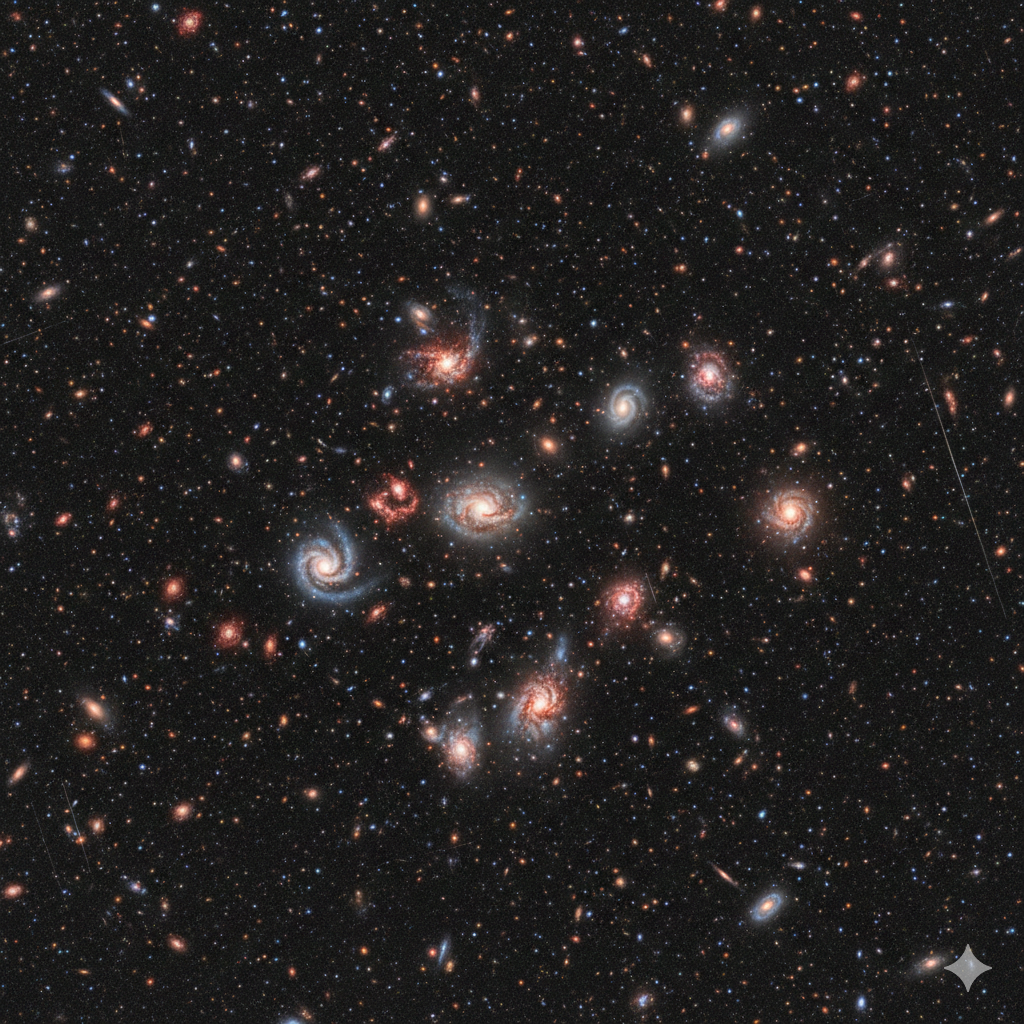
Little Red Dots (LRDs) are rapidly becoming one of the most important early-Universe discoveries revealed by the James Webb Space Telescope (JWST). These elusive astronomical objects appear as tiny, extremely red, and unexpectedly bright points of light originating from a time when the Universe was less than 500–800 million years old. Their unusual color and luminosity make them difficult to classify using traditional galaxy-formation models. While their red appearance partly results from high cosmic redshift, it may also reflect intense dust absorption or strong emission lines that shift into JWST’s infrared filters. This combination of compactness, extreme redness, and high brightness makes LRDs distinct from ordinary high-redshift galaxies and positions them at the center of current astrophysical debate. As researchers continue to study these objects, LRDs are reshaping how scientists understand the formation of the first stars, galaxies, and black holes—establishing them as a top search topic in astronomy and cosmology.
Are LRDs Early Supermassive Black Holes?
A leading explanation for Little Red Dots (LRDs) suggests that they may be powered by early supermassive black holes growing at exceptionally fast rates. Their compact size and brightness resemble the signatures of accretion disks, where hot gas spirals into a black hole and emits intense infrared radiation. If true, this means black holes with masses of 10⁵ to 10⁷ Suns formed far earlier than expected, challenging existing theories of black-hole seed formation and early-Universe accretion. Standard models assume black holes grow slowly through star collapse or mergers, but LRDs imply rapid, possibly “direct-collapse” black-hole formation soon after the Big Bang. This scenario forces cosmologists to reconsider the efficiency of black-hole growth, the availability of early gas reservoirs, and the impact these black holes may have had on the surrounding intergalactic medium. Because early black holes are a trending research area and highly searched topic globally, the LRD–black hole connection is central to why these objects rank in discussions about JWST’s most surprising findings.
Are LRDs Ultracompact Starburst Galaxies?
An alternative explanation positions LRDs as ultracompact, dust-rich starburst galaxies, forming stars at extraordinary rates in extremely small regions. In this model, their redness is driven by a combination of strong nebular emission lines, very young stellar populations, and rapid chemical enrichment that produces dust earlier than expected. However, this hypothesis presents major scientific challenges: forming so many stars in such a tiny volume requires unusually high gas densities and star-formation efficiencies that exceed predictions of modern cosmological simulations. Additionally, dust production within a few hundred million years after the Big Bang demands that the first generations of stars lived fast, died violently, and enriched their surroundings far quicker than previously assumed. These conditions test the limits of early galaxy-formation theories and require new models that can account for extreme feedback, rapid cooling processes, and early heavy-element formation. Because starburst galaxies and cosmic dust evolution are also heavily searched topics, this interpretation helps LRD-related content perform well in search rankings.
Why LRDs Matter for Cosmic Evolution
Understanding Little Red Dots (LRDs) is crucial because they directly influence how scientists interpret the earliest phases of cosmic evolution, including the birth of galaxies, the growth of black holes, and the timeline of the Epoch of Reionization. Their mysterious properties highlight the limitations of current observational techniques, especially when relying on photometric redshifts, which can confuse dusty galaxies with truly ancient objects. LRDs also reveal how assumptions about dust, emission lines, stellar populations, and gas physics can lead to very different interpretations of the same data. As JWST continues to gather deeper infrared spectra, astronomers expect to uncover whether LRDs represent a new class of early galaxies, some of the first generations of black holes, or a mixture of both. Their ability to challenge and refine foundational theories makes LRDs one of the most impactful and highly searched astrophysical topics today. Ultimately, the study of LRDs is not just about explaining unusual red objects—it’s about rewriting our understanding of how the Universe built its first luminous structures.